Hair Transplant Turkey Before and After: 12-Month Timeline
Hair transplant Turkey before and after: a month-by-month timeline of shock loss, the texture shift, and how to judge clinic result photos honestly.
Published
Key Takeaways
- Hair transplant results are usually judged at about 12 months, by which point density and texture have settled enough to assess.
- The first 14 days are the anchoring phase, when grafts survive on plasma imbibition before a permanent blood supply forms.
- Shock loss between weeks 3 and month 3 is a normal reset, not a failure — the follicle sheds its temporary shaft to build a permanent root.
- Between months 7 and 10, transplanted hair matures from wiry, fine strands into your natural caliber and wave pattern.
- Graft survival after modern FUE is generally reported as high, though published figures vary with how survival is defined and counted. What reliably influences it is how follicles are extracted, handled and placed.
Most people researching this procedure start the same way: typing "hair transplant Turkey before and after" into a search bar and scrolling through galleries of strangers. Those photographs are worth studying — but only once you know what a fair comparison actually looks like and how long each stage of growth takes. Turkey, and Istanbul in particular, is where a large share of international patients travel for hair restoration, so most of the results circulating online were photographed in a Turkish clinic under conditions nobody explains to you.
This guide sets out the full twelve months as they typically unfold — the anchoring phase, the shedding almost nobody is warned about, and the late texture shift that decides how the result finally reads. It then explains how to judge hair transplant in Turkey before and after photographs critically rather than hopefully, so that you are comparing your own month three against the right benchmark instead of somebody else's month twelve.
📊 Our Founding Team's Patient Data (2025-2026, prior to launching Wholecares)
- 1,200+ international patients served from over 30 countries worldwide.
- Internationally licensed partner clinics.
- Structured aftercare: a 12-month follow-up program formed part of the standard pathway.
Hair Transplant Turkey Before and After: The Anchoring Phase, Days 1–14
The first two weeks following your procedure are the most critical for graft survival. During this window, the transplanted follicles are physically settling into their new environment. They are not yet anchored by blood flow; they are surviving on a localized nutrient exchange called plasma imbibition.
Safety is the question behind every other question. In these early days, your primary responsibility is protection. The microscopic incisions must heal without interference. While you may see hair shafts present immediately after the surgery, these are merely "placeholders." They provide a preview of the new hairline, but they are not the final result. At this stage, the follicles are preparing for a significant transition, and understanding the full recovery timeline helps you set realistic expectations for each milestone. This matters more for international patients than for local ones: if you have flown to Istanbul for surgery, you will usually be back home in the UK or Europe well before anything worth photographing has happened.
What Is Shock Loss After a Hair Transplant?
Between week three and month three, most patients experience what is usually called shock loss. The name is unfortunate, because nothing is being lost: the follicle stays where it was placed and sheds only the shaft it was carrying. If you want a deeper look at this stage, see our guide to temporary shedding after a hair transplant.
This is not a failure of the surgery. It is a necessary biological pause. The trauma of being moved from the donor site to the recipient area causes the follicle to enter the telogen (resting) phase, as explained by the Mayo Clinic. It sheds the old hair shaft to redirect all available metabolic energy toward anchoring the root and establishing a permanent blood supply.
Understanding it as a reset rather than a loss removes most of the anxiety: the follicle is clearing the shaft it carried in order to grow a new one. During this "Ugly Duckling" phase, your scalp may look thinner than it did before the surgery. It is a stage in the process rather than a sign that something has gone wrong.
Why Does Donor Area Density Matter?
Most of the attention in a hair transplant goes to the recipient area, because that is what gets photographed. The donor area deserves at least as much, because over-harvesting there is the one part of a poor result that cannot be revised later: donor supply is finite, and a thinned or patchy back of the head is difficult to repair.
The usual approach to protecting it is to harvest in a scattered pattern spread across the whole safe donor zone rather than in a concentrated block, so that the remaining density stays reasonably uniform as the surrounding hair grows back. This is standard practice rather than a proprietary technique, and it is a fair thing to ask any surgeon to describe before you book.
| What to ask about the donor area | Why it matters |
|---|---|
| How will extraction be distributed across the donor zone? | Grafts taken evenly across the safe zone leave less visible change than grafts taken in concentrated patches. |
| How many grafts do you consider safe for my donor density, and how did you arrive at that number? | The ceiling depends on your own donor density and hair caliber, not on the package you bought. A number quoted before anyone has examined you is a sales figure. |
| How much donor capacity will be left for a second procedure? | Hair loss usually continues in the untreated areas, so many patients need a second session later. Donor supply is finite and cannot be replaced. |
| May I see donor-area photos of past cases at six months or later? | Most published result photos show only the front. The back of the head is where over-harvesting becomes visible, which is exactly why it is rarely shown. |
These questions matter because a hair transplant should not be a trade-off between the front of your head and the back of it. A surgeon who answers them precisely is planning for your donor area as well as your hairline.
Why Does Transplanted Hair Change Texture at Months 7–10?
By month six, most patients see significant coverage. However, the hair often feels different: it may be finer, frizzy, or have a wiry texture. This is a common point of concern that requires clinical perspective.
Between months seven and ten, you experience the Texture Shift. The follicle, now fully integrated and receiving a robust blood supply, begins to produce hair of a higher caliber. The hair "matures," softening and adopting your natural wave or curl pattern. This is not a shortcut; it is a physiological maturation. You must allow the hair to cycle through several growth phases before it reaches its final density and sheen.
What Makes One Person's Result Different From Another's?
Two patients can undergo technically identical surgery, follow the same aftercare, and still arrive at visibly different results. Density is not created in the operating room; it is negotiated between what the donor area can supply and what the recipient area demands. This is the single most important thing to hold in mind while scrolling a Turkish clinic's gallery: the case you are looking at was decided by variables that may have nothing in common with yours. Several of them are set before the first graft is placed:
- Donor supply and hair caliber. Thicker individual hairs cover more ground than fine ones. Two people with the same graft count but different caliber will not look the same.
- Contrast between hair and skin. Where hair color sits close to skin tone, coverage reads as denser at the same graft count. High contrast - dark hair against pale skin - is the least forgiving combination.
- Curl. Wave and curl lift hair away from the scalp and cover more surface per follicle than straight hair lying flat.
- The size of the area being covered. A limited hairline restoration concentrates a given supply; extensive loss spreads it thinner.
- Age and ongoing native loss. Transplanted follicles are permanent, but untreated hair around them may continue to thin - which is why long-term planning matters.
- Scalp and general health. Skin condition, circulation, smoking, and how carefully the healing phase is protected all bear on how follicles settle.
Understanding these before surgery is what makes a result satisfying afterwards. A surgeon who explains which variables work in your favor and which work against you is offering something more useful than a photograph of somebody else.
Why Do Hair Transplant Before and After Photos Differ So Much Between Clinics?
Before-and-after images are the most persuasive material in hair restoration and the least standardized. Two photographs of the same head, taken minutes apart, can tell opposite stories depending on how they were made. Learning to read them stops you judging your own progress against a picture that was never a fair comparison — and it is the fastest way to tell a serious clinic from a well-run marketing operation.
| What to look for | Why it matters |
|---|---|
| Lighting direction and harshness | Overhead or direct light throws the scalp into shadow and exaggerates thinning; soft, even light conceals it. A darker "before" and a brighter "after" may show lighting, not growth. |
| Wet versus dry hair | Wet hair clumps and reveals the scalp. A wet "before" set against a dry, styled "after" is not a like-for-like pair. |
| Camera angle and head tilt | Tilting the head forward shows more scalp. Small changes in angle produce large changes in apparent density. |
| Hair length and styling | Longer hair combed forward covers ground shorter hair cannot, and product adds apparent thickness. |
| Concealers and fibers | Cosmetic fibers and scalp pigments can transform an image without a single graft being involved. |
| The stated interval | An "after" with no date attached tells you nothing. Ask how long after surgery it was taken. |
| Whose head it is | Another person's donor density, caliber, color contrast, and extent of loss are not yours. Their outcome does not forecast yours. |
None of this makes photographs worthless. It means the useful ones are consistent: same lighting, same angle, same length, same styling, interval stated plainly. A provider willing to show the unflattering months alongside the flattering ones is telling you more than one that shows only the finish.
How to Read Before-and-After Results From Turkish Clinics
The principles above apply anywhere. What changes in Turkey is volume: you will be sent large albums, usually unlabeled, often before anyone has examined your scalp. Four checks turn that flood into something usable.
Judge the pair, not the picture. A before and an after are evidence only when both halves were made at the same angle, in the same lighting, at the same hair length, and in the same wet or dry state. Break one of those and the pair describes a camera, not a surgeon.
Establish which month you are seeing. A photo taken at month six is a progress report, not an outcome: the new hair is typically still fine, wiry, and incompletely grown in. Months seven to twelve are what add caliber, the texture shift, and the last of the density. Where no interval is stated, assume the flattering answer and ask.
Ask for the back of the head. Credible documentation includes the donor area, not only the recipient area. The donor zone is where over-harvesting shows, and it is the half of the result quietly traded away when graft counts are pushed beyond what the scalp can support.
Look for a case that resembles you. Match on Norwood stage, hair caliber, curl, and the contrast between your hair color and your skin. A gallery composed entirely of dense, dark, straight-haired results is a warning sign rather than a credential — it means the clinic is publishing the hair types that photograph best, and tells you nothing about how finer hair, higher contrast, or more advanced loss is handled.
Then make one request at consultation: an unedited case at your own Norwood stage and hair type, photographed at twelve months, with the interval stated and the donor area included. A clinic comfortable with scrutiny can usually produce it; one that redirects you to a montage has answered anyway. The wider safety red flags are worth reading before you commit.
How Should You Photograph Your Own Progress?
The most useful thing you can do during the year is build your own honest record. Memory is a poor witness to gradual change - you see your hairline every morning, which is exactly why you will not notice it moving. A consistent series is also what a clinician needs if you raise a concern remotely. Keep it repeatable rather than flattering:
- Fix the conditions and never change them. Same room, same time of day, same light source, same distance. Indirect natural daylight is the most honest and the easiest to reproduce.
- Photograph dry, clean, unstyled hair. No products, no fibers, no combing forward. You are documenting, not presenting.
- Use a fixed set of angles every time. Front, both sides, the crown from above, and the donor area at the back. Add the hairline straight on, head level rather than tilted.
- Turn the flash off. Direct flash flattens texture and makes density look better than it is, which defeats the purpose.
- Shoot on the same day each month and label the files by date. A folder ordered by date turns a year of ambiguous impressions into one clear trajectory.
Do this and the shedding phase becomes far less alarming, because you will have evidence of where you started rather than a recollection of it.
Why Is 12-Month Aftercare Important After a Hair Transplant?
Much of a hair transplant result rests on graft survival, and there is no single authoritative figure for it: published rates vary with how survival is defined, how it is counted, and who is counting. What reliably influences it is how follicles are extracted, handled, kept and placed — which is a question about the surgical team rather than about the technique label. Our overview of hair transplant success rates explains why the published figures differ so much. This is why Wholecares coordinates aftercare through the first year, treating it as a supervised medical journey.
The first-year aftercare Wholecares is set up to coordinate is designed around the variables of daily life. It is intended to include:
- Regular progress reviews: a native-speaking personal health manager to help you keep track of your progress and raise anything that concerns you with the clinic.
- Aftercare instructions: your surgeon's own washing, scalp-care and medication instructions, relayed and followed up in your language.
- Medical complication insurance: a policy arranged before travel; what it covers, and its limits, are set out in that policy.
Aftercare is worth asking about before you book rather than after you land, because a transplant is a twelve-month process and most of it happens after you have gone home. Wholecares intends to work only with hospitals holding recognized quality accreditation.
Summary of the 12-Month Timeline
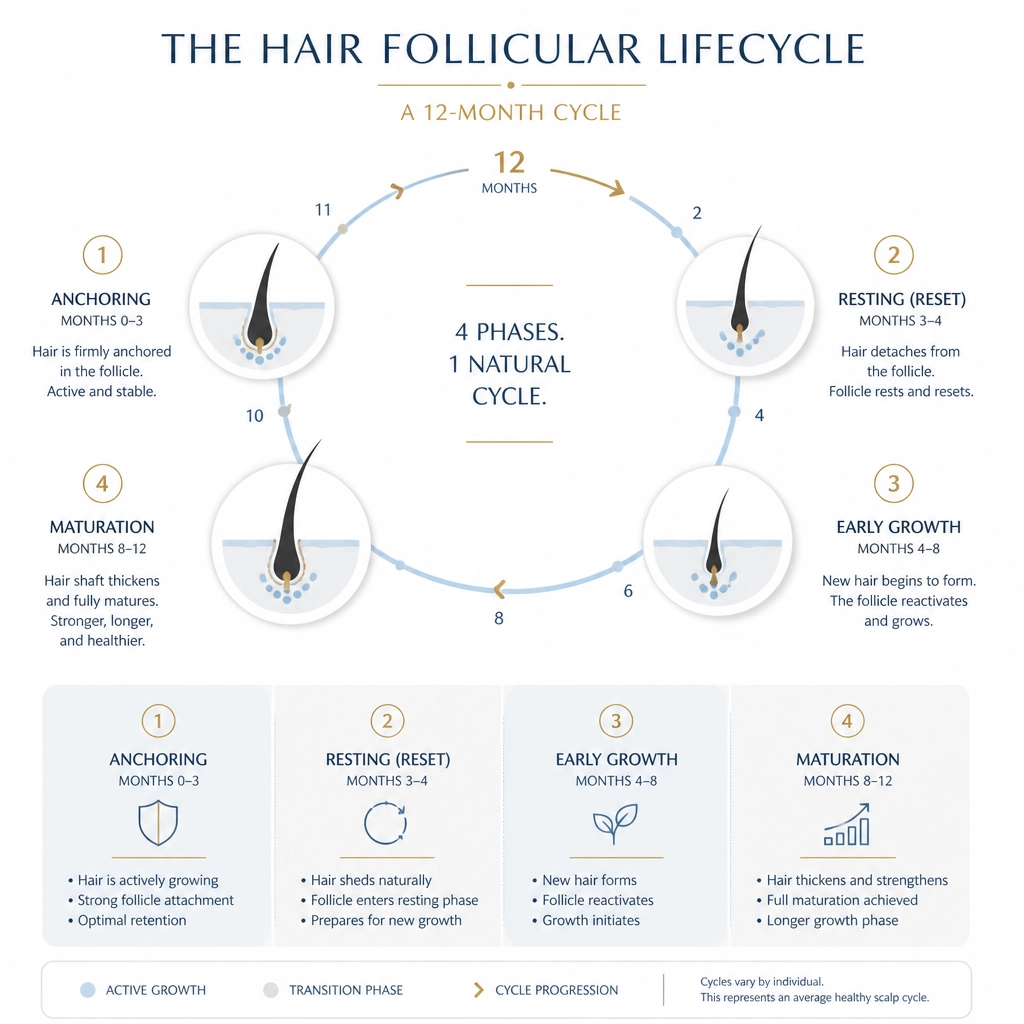
- Month 0–1 (The Anchoring): Grafts settle; shedding of the transplanted shafts begins.
- Month 2–3 (The Dormancy): The scalp is resting and growth is minimal. This is the quietest stretch, and the hardest.
- Month 4–6 (The Emergence): Fine, thin hairs begin to sprout. Initial coverage appears.
- Month 7–10 (The Maturation): Texture shifts from wiry toward your natural caliber, and density continues to build.
- Month 12 (Settled): The result is settled enough to judge. The transplanted follicles keep their resistance to the loss pattern; the native hair around them does not.
The Bottom Line
Choosing to undergo a hair transplant is a significant life event that requires discipline and patience. The NHS confirms that final results typically take 12 months or more to fully develop. The months between the operating room in Istanbul and a settled result back in London or Berlin are made up of biological stages that cannot be rushed. Understanding why the shedding happens and why the texture matures late will not change the timeline, but it will stop you reading a normal month three as a failed procedure.
At Wholecares, we do not perform the procedure ourselves; we coordinate it with licensed partner hospitals and handle the arrangements around it. Clinical decisions rest with the treating surgeon, and whether a transplant is appropriate for you at all is a question for a qualified doctor who has examined your scalp.
Our Founding Team's Track Record (Prior to Launching Wholecares)
Prior to launching Wholecares, our founding team supported 1,200+ international patients from 30+ countries, working with licensed partner hospitals in Istanbul, with a structured 12-month aftercare program for hair restoration cases. Partner clinics were licensed and health-tourism authorized, and a dedicated, native-speaking health manager with regular progress reviews formed part of the standard pathway.
Considering hair transplant abroad? Wholecares can help you compare Hair Transplant packages offered by licensed partner hospitals in Istanbul, Turkey — with transparent pricing and a free consultation.
Explore Hair Transplant in Turkey →Frequently Asked Questions
Why does my hair transplant look thinner after two months?
This is shock loss. Around weeks three to twelve the transplanted follicles enter a resting phase and shed their temporary hair shafts to redirect energy toward anchoring the root and building a blood supply. The follicle stays alive, and permanent hair regrows within a few months. It is a normal, expected stage.
How long do hair transplant results take to fully show?
Final hair transplant results typically take about 12 months. Fine hairs emerge around months four to six, density builds through months seven to ten as the texture matures, and full thickness and natural texture are usually visible at the one-year mark. Results cannot be rushed because the follicles must cycle through several natural growth phases.
How do I know if my donor area was over-harvested?
If you see visible patches, holes, or uneven thinning in the donor area after about three months, it can signal poor extraction technique. A well-managed donor area heals uniformly. Ask your surgeon in advance how extraction will be spread across the safe zone, how many grafts they consider safe for your donor density, and how much capacity will remain for a possible second procedure.
When can I return to exercise after a hair transplant?
Light walking can usually resume after about 7 days. Strenuous cardiovascular activity, heavy lifting, and contact sports should be avoided for roughly 14 to 21 days. Early exertion raises blood pressure and sweating, which can dislodge fragile grafts before they anchor. Always follow the specific timeline your surgeon provides for your case.
Does a hair transplant last forever?
Transplanted hair is harvested from the permanent donor zone, which is genetically resistant to DHT, the hormone responsible for pattern balding. Those relocated follicles keep their resistance and are considered permanent. However, your existing native hair can still thin over time, so long-term maintenance and monitoring help protect your overall appearance.
Are hair transplant Turkey before and after photos reliable?
They are reliable only when the two images are genuinely comparable. The before and the after must share the same camera angle, the same lighting, the same hair length, and the same wet or dry state, and the interval between them must be stated. Ask which month the after photo was taken in, whether the donor area is included, and whether any concealer or fiber product was used. A clinic that also documents the awkward middle months is giving you more information than one that publishes only finished results.
When do hair transplant in Turkey before and after results become final?
At around twelve months, because the timeline is biological rather than geographical and is the same wherever the surgery is performed. Fine hairs typically emerge between months four and six, density builds through months seven to ten as the texture matures, and most patients see their settled result at the one-year mark. A case photographed at month six is a progress update rather than an outcome, so always check the stated interval before measuring your own stage against it.
What should Turkey hair transplants before and after photos include?
Credible documentation shows the donor area at the back of the head as well as the recipient area, states how many months after surgery each photo was taken, and covers a range of Norwood stages, hair calibers, curl patterns, and hair-to-skin color contrasts. If every published case is dense, dark, and straight-haired, the clinic is showing its most flattering hair types rather than a representative sample of its work. Ask to see an unedited case that matches your own stage and hair type.
Recommended Reading
This information is for informational purposes only and does not constitute medical advice. Please consult your physician.
