Hair Transplant in Turkey It's Not Just Hair.
It's You, Again.
Reclaim your image and confidence. We help you turn back the clock to your factory settings with natural-looking results.
Reclaim your image and confidence. We help you turn back the clock to your factory settings with natural-looking results.
Hospital-based procedures, not clinic rooms
Certificate of procedure
Included in the partner clinic package
Sapphire & DHI Pens
A solution for hair loss, tailored to your unique structure.
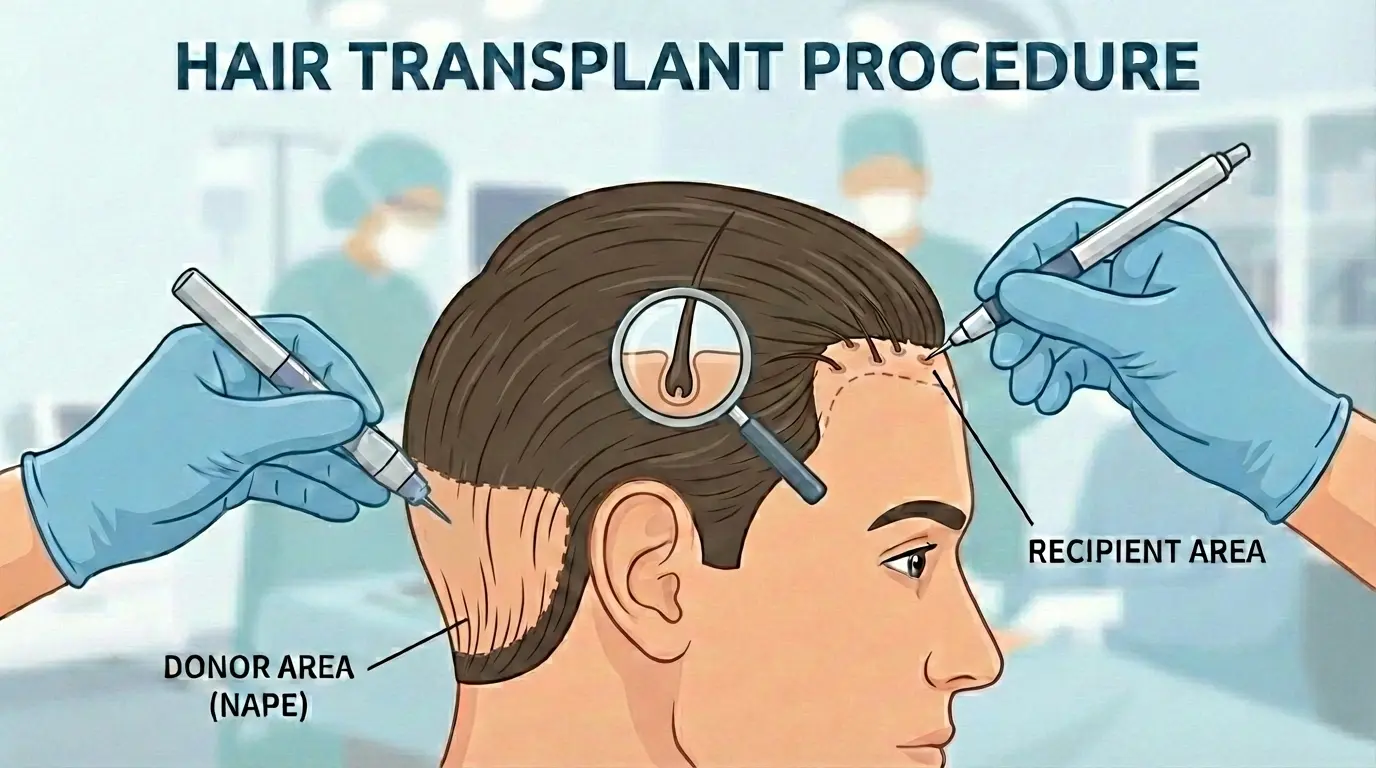
A hair transplant moves healthy hair follicles from a donor area (usually the nape) to thinning or balding areas. According to the International Society of Hair Restoration Surgery (ISHRS), these follicles are genetically resistant to shedding.
Suitable candidates are typically men and women aged 25+ whose hair loss has stabilized and who have sufficient donor density. Wholecares coordinates FUE, DHI and Sapphire FUE procedures at licensed partner hospitals in Istanbul, Turkey, where hair transplant typically costs €2,390–€3,290.
According to the International Society of Hair Restoration Surgery (ISHRS), it involves transferring healthy hair follicles (grafts) from a donor area (usually the nape) to balding areas. Since these follicles are genetically resistant to shedding, they retain that resistance once relocated.
Ideally for men & women aged 25+ whose hair loss has stabilized. Whether it's male-pattern baldness (androgenetic alopecia) or thinning due to stress, if you have sufficient donor hair, you are likely eligible.
Hair loss in women follows a different pattern. Partner clinics use specialized "Unshaven" techniques to increase density without the need to shave the entire head, preserving your existing hairstyle.
Maximum Density. Minimum Recovery. Natural Design.
Duration: 6-8 Hours
Anesthesia: local; the numbing injections are briefly uncomfortable
Hospital Stay: Outpatient (No overnight)
Recovery: Typically back to work in 3 days
GET A QUOTEHair transplant cost in Turkey: what moves the price →
Turkey is consistently the most affordable major destination for hair restoration — typically three to five times less than the UK or the USA for comparable surgery. The figures below are typical market ranges by country, not Wholecares quotes. Wholecares coordinates treatment at licensed partner hospitals in Istanbul and passes on the hospital's exact figure once your donor area and graft count are assessed.
| Country | Average Price (EUR) |
|---|---|
| Turkey | €2,390 - €3,290 |
| United Kingdom | €6,690 - €31,500 |
| United States | €11,300 - €26,200 |
| Germany | €6,100 - €13,200 |
| Spain | €5,700 - €15,500 |
| France | €7,500 - €15,700 |
| Ireland | €6,700 - €23,000 |
Your treatment is paid directly to the hospital — we never handle your money. Our coordination service is covered by the hospital, so you pay Wholecares nothing.
From your arrival to your safe return, every step is planned for your comfort.
Airport transfer Hotel check-in Meet your health manager
Meeting your surgeon first Comprehensive pre-op tests
Operation in a Licensed partner hospital
Hotel rest with health manager support Final Check-up
Transfer to airport Post-op follow-up
"What if something happens when I go back home?" is a valid concern. It is one reason a medical complication insurance policy is arranged individually for each patient before they travel, with what it covers and its limits set out in that policy.
A Medical Complication Insurance policy is prepared for you ahead of your procedure. What it covers, and the limits that apply, are set out in the policy document, which you receive before you decide to go ahead.
Verify Coverage DetailsThe policy comes with the partner hospital's package rather than being sold as a generic add-on, and it is issued by an insurer rather than by Wholecares. The policy is governed by Turkish law, so UK schemes such as the Financial Services Compensation Scheme and the Financial Ombudsman Service do not apply to it, and any claim is made to the insurer.
The complications and situations the policy covers are described in the policy document itself.
You receive the wording so you can review the cover, and any exclusions, before making a decision.
Any cover is provided within the limits determined by the policy.
Your Personal Health Manager
On WhatsApp, in your language
Traveling for surgery can be daunting. That's why a dedicated, native-speaking assistant is arranged to help guide you through every step.
No language barriers. Your assistant communicates with you in your native language, ensuring you understand everything.
Your manager is with you from hotel check-in to hospital transfers, which the partner clinic arranges, so you can focus on healing.
Have a question about your medication or your recovery? Your health manager is reachable by message during treatment and recovery.
Honest expectations. Every stage explained.
Your surgeon analyzes your donor capacity and designs your hairline. This is where art meets medicine.
Under local anesthesia, grafts are extracted and implanted. You can watch TV or listen to music during the process.
You may have mild swelling. Scabs will form and fall off within 10 days. The clinic provides a special washing set and lotion.
Important: The transplanted hair will shed. This is normal! The roots remain healthy under the skin.
New hair starts growing at 3 months. By month 6, you see significant coverage. Full results are visible at 12 months.
The risks are real rather than minor. Infection and temporary numbness are the common ones; a poorly placed hairline, wrong graft angles, permanent thinning of the donor area and, rarely, scalp necrosis are the ones that do not reverse. Who operates and where is what changes the odds. Your health manager supports you during recovery.
Explore our in-depth, evidence-based articles.
What should you expect, and what should you ask a clinic? Types of guarantees, and the red flags to watch for.
Read Article →A detailed comparison of modern hair transplant techniques — which method is right for you?
Read Article →Transparent pricing guide covering per-graft costs, package pricing, and financing options worldwide.
Read Article →Day-by-day recovery guide from surgery through 12-month full results — what to expect at each stage.
Read Article →Evidence-based success rates by method, graft count, and patient profile — honest numbers you can trust.
Read Article →What changes month by month, and how to judge clinic result photos honestly.
Read Article →By the Wholecares team · Published · Updated
